Revolutionary Movements Every Student Must Explore
16 October 2026
Let's be honest about something. Most students encounter "revolutionary movements" the same way they encounter fiber: someone insists it's good for them, it arrives in a bland package, and everyone nods politely while secretly checking their phone. The French Revolution gets a week. The Industrial Revolution gets a slideshow. Maybe a documentary with dramatic music. Then it's on to the next unit, and nobody remembers why any of it mattered.
Here's the thing nobody tells you. Revolutions are not dusty artifacts. They are case studies in how power actually works, how ordinary people organize, how ideas travel, and how systems collapse or adapt. If you want to understand politics, economics, media, or your own group chat dynamics, revolutions are the laboratory. They are messy, contradictory, and full of lessons that textbooks flatten into timelines.
This article is not a listicle of "top ten uprisings." It is a guide to thinking about revolutionary movements as a student, with enough depth to actually use what you read. We will cover what makes a movement revolutionary versus merely reformist, why some succeed and others fail, which movements deserve serious attention, and how to study them without drowning in ideology or cynicism.
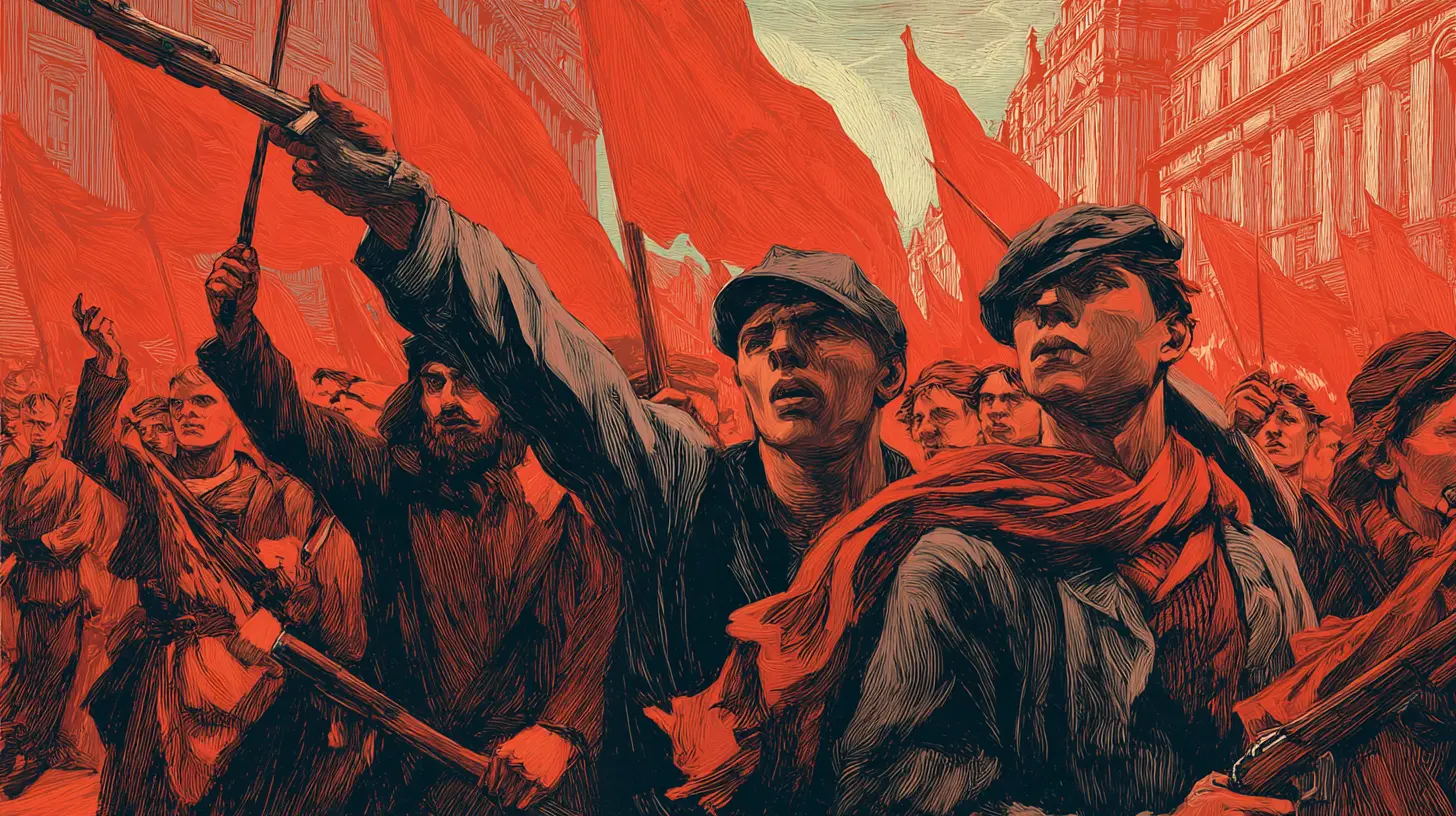
What Actually Counts as a Revolutionary Movement
Before you can study revolutions, you need a working definition. Otherwise everything from a school dress code protest to a coup gets lumped into the same bucket, and the analysis falls apart.A revolutionary movement seeks fundamental change to the political, economic, or social order. Not tweaks. Not adjustments. It aims to replace or transform the underlying system. A reform movement, by contrast, works within the existing structure. Suffrage campaigns, labor regulations, and anti-corruption drives can be radical in practice, but they often target specific rules rather than the whole architecture.
That distinction matters because it changes the questions you ask. For reform movements, you ask: what leverage did they use, and what did they win? For revolutionary movements, you ask: what made the existing order vulnerable, and what replaced it?
There is also a spectrum. Some movements start reformist and become revolutionary when the state refuses to budge. Others begin with grand revolutionary rhetoric and settle for modest reforms. Both patterns teach you something about how power responds to pressure.
The Three Ingredients Most Revolutions Share
Scholars disagree on a lot, but most accounts converge on a few conditions. You do not need all three for a movement to emerge. You do need them for one to have a real shot at transforming a system.First, a legitimacy crisis. The ruling order loses its claim to authority, often because it fails to deliver on promises or responds to grievances with brutality. Second, mobilization capacity. People need networks, communication channels, and a sense of shared identity. Third, a plausible alternative. Revolutions rarely succeed on anger alone. There has to be some vision, however vague, of what comes next.
Why does this framework help? Because it stops you from treating revolutions as spontaneous explosions of rage. They are processes, with preconditions and phases. That is far more useful than memorizing dates.
The Movements Worth Your Time (And Why)
There are dozens of movements you could study. These are the ones that repay careful attention, because they shaped the modern world or reveal something you cannot learn elsewhere.The Haitian Revolution (1791-1804)
This is the revolution that most curricula skip or rush. It is also one of the most consequential in human history.Enslaved people in the French colony of Saint-Domingue rose up, fought multiple European powers, and established Haiti as the first independent Black republic. The scale of the achievement is hard to overstate. It was not a military coup or an elite power grab. It was a mass uprising that dismantled slavery and colonial rule simultaneously.
Why study it? Because it exposes the limits of the "liberty" rhetoric coming out of the American and French revolutions. Both of those movements talked about universal rights while maintaining slavery or colonial empires. Haiti forced the contradiction into the open. It also shows how international pressure and economic isolation can punish a revolution long after the fighting ends. France demanded crippling reparations, and other powers refused recognition for decades. The revolution succeeded militarily and paid for it economically for generations.
Common mistake: treating Haiti as a footnote to the French Revolution. It was its own event with its own logic, and it terrified slaveholding powers across the Americas for good reason.
The Russian Revolution (1917)
You cannot understand the twentieth century without it. The Russian Revolution toppled a monarchy, brought a radical socialist party to power, and set off a chain of events that shaped global politics for seventy years.But here is where most students go wrong. They treat it as a single event, usually the Bolshevik takeover in October. In reality, it was a process with multiple phases, competing factions, and enormous contingency. The February Revolution that ended the tsar's rule was not led by the Bolsheviks. The Provisional Government that followed made a series of decisions, especially staying in World War I, that destroyed its own legitimacy. The Bolsheviks were better organized, better positioned, and ruthless when it mattered.
Why study it? Because it is the clearest case of revolutionary theory meeting revolutionary practice, with all the contradictions that entails. It also raises uncomfortable questions about vanguard parties, authoritarian drift, and whether revolutionary ends justify revolutionary means. You do not have to like the answers to learn from the questions.
The Chinese Revolution (1949 and Its Aftermath)
The Chinese Communist Party's rise to power followed decades of civil war, foreign invasion, and internal collapse. The revolution itself is inseparable from the longer story of China's twentieth century.What makes it worth studying is the scale and the stakes. A country with hundreds of millions of people underwent forced collectivization, mass campaigns, and eventually market reforms that lifted huge numbers out of poverty while also producing enormous human costs. The revolution did not end in 1949. It continued through policy shifts, purges, and economic transformations that are still playing out.
Why study it? Because it complicates the simple narrative that revolutions either succeed or fail. The Chinese Revolution succeeded in seizing power and transforming society. It also produced outcomes its own architects did not fully anticipate. That is a lesson about unintended consequences you will not get from a textbook summary.
The Cuban Revolution (1959)
Small island, outsized influence. The Cuban Revolution overthrew a dictator, aligned with the Soviet Union, and became a symbol for both supporters and critics of revolutionary politics worldwide.Why study it? Because it is a case study in how a relatively small guerrilla movement can take power, and how external patronage (in this case, Soviet support) can sustain a revolution that might otherwise have collapsed under pressure. It also shows how revolutions become entangled in great power politics, and how ordinary Cubans experienced both the gains and the costs.
Do not treat it as either a paradise or a prison. Treat it as a complex historical event with real consequences for real people, and study the primary sources from multiple perspectives.
The Anti-Apartheid Movement in South Africa
This one is often taught as a moral story, which is fine as far as it goes, but it undersells the strategic lessons.The anti-apartheid struggle combined mass protest, international pressure, armed resistance, labor organizing, and economic sanctions over decades. It was not a single revolution but a long campaign with many fronts. The transition to democracy in the early 1990s involved negotiation, compromise, and unresolved tensions that still shape South African politics.
Why study it? Because it shows that revolutionary change does not always look like a sudden rupture. Sometimes it is a grinding, multi-generational effort that wears down a system from inside and outside simultaneously. It also raises hard questions about negotiation versus confrontation, and what happens when a movement achieves political power but not economic transformation.
The Iranian Revolution (1979)
A broad coalition of groups, including leftists, students, and religious factions, overthrew the Shah. The aftermath concentrated power in the hands of clerics, producing a theocratic state that persists today.Why study it? Because it is a case study in coalition dynamics. Revolutionary coalitions are often unstable. The groups that do the most visible work are not always the ones who end up in charge. The Iranian Revolution also shows how a movement can be genuinely popular at the outset and still produce an authoritarian outcome. That is not a contradiction. It is a recurring pattern.
Why Revolutions Fail (Or Succeed) More Often Than You Think
Pop quiz: how many revolutions actually achieve their stated goals? If you guessed "fewer than you would hope," you are paying attention.Success is hard to define. Did the revolution seize power? Did it transform society? Did it survive external pressure? Did it deliver on its promises? A movement can succeed on one metric and fail on another.
The Role of External Pressure
Revolutions do not happen in a vacuum. Foreign powers intervene, impose sanctions, fund counter-revolutionaries, or offer support. The Haitian Revolution faced isolation and reparations. The Russian Revolution faced foreign intervention and civil war. The Cuban Revolution survived partly because of Soviet aid.Why does this matter? Because it means you cannot evaluate a revolution purely on its internal dynamics. The international context is part of the story, and often the decisive part.
The Problem of Consolidation
Winning is one thing. Governing is another. Revolutionary movements often struggle with the transition from opposition to authority. The skills that make a good insurgent are not the same skills that make a good administrator. Internal factions compete. Promises collide with reality. External threats justify repression.This is where most revolutions either stabilize or fracture. The ones that stabilize usually find ways to build institutions, manage dissent, and deliver some tangible improvements. The ones that fracture often descend into infighting, authoritarianism, or collapse.
The Myth of the Clean Revolution
There is no such thing as a clean revolution. Every one involves violence, coercion, or the threat of it. Every one produces winners and losers. Every one leaves scars that outlast the immediate conflict.That is not a reason to dismiss revolutions. It is a reason to study them honestly, without romanticizing or demonizing. If you want to understand power, you have to look at what people do when they have it and when they are trying to take it.
How to Study Revolutionary Movements Without Getting Lost
Here is where most students go wrong. They read one book, watch one documentary, and think they understand a revolution. They do not. Revolutions are contested terrain. Historians disagree. Participants disagree. The sources themselves are often partisan.So here is a practical approach.
Read Primary Sources, Not Just Summaries
Primary sources are messy, biased, and incomplete. That is exactly why they are useful. Read speeches, pamphlets, letters, and memoirs from multiple sides. Compare them. Notice what each source emphasizes and what it omits.For the Russian Revolution, read Lenin and also read the memoirs of people who opposed him. For the Haitian Revolution, read accounts from enslaved people alongside colonial records. The gaps and contradictions are where the real learning happens.
Compare Movements Across Time and Place
Revolutions are not identical, but they rhyme. Comparing them helps you see patterns that a single case study would hide. Why did some movements build durable institutions while others collapsed into factionalism? Why did some negotiate while others fought to the end?Comparison also protects you from overgeneralizing. There is no single formula for revolution. There are recurring dynamics, but context matters enormously.
Pay Attention to Ordinary People
Revolutions are usually taught through the lens of leaders. That is a mistake. Leaders matter, but so do the workers, peasants, soldiers, and students who made the movement possible. Their experiences often reveal more about how revolutions actually function than the speeches of their figureheads.Look for sources that center everyday people. Diaries, oral histories, and local archives can be harder to find, but they are worth the effort.
Question the Narrative
Every revolution has an official story, and every official story has omissions. Your job as a student is not to accept the story but to interrogate it. Who benefits from this version of events? Who is left out? What would change if we looked at it from a different angle?That is not cynicism. It is intellectual rigor. It is also the difference between memorizing history and understanding it.
Common Mistakes Students Make (And How to Avoid Them)
Let's run through the big ones.Treating revolutions as inevitable. They are not. They depend on contingency, leadership, timing, and luck. The outcome could have been different.
Treating revolutions as purely ideological. Ideas matter, but so do material conditions, organizational capacity, and external pressure. Reducing everything to ideology blinds you to how power actually works.
Assuming all revolutions are the same. They are not. Context shapes outcomes. A revolution in an agrarian empire looks different from one in an industrial city-state.
Ignoring the aftermath. The revolution is not over when the old regime falls. The consolidation phase often determines whether the movement's goals are realized or betrayed.
Reading only one side. If you only read sympathetic accounts, you will miss the costs. If you only read hostile accounts, you will miss the achievements. Read both, and read critically.
Practical Advice for Students Who Want to Go Deeper
If you are genuinely interested in this topic, here is what to do next.Pick one revolution and study it in depth. Read at least three books from different perspectives. Find primary sources. Write about it, even if it is just for yourself. The act of writing forces you to clarify your thinking.
Then pick a second revolution from a different region and compare them. Look for similarities and differences. Ask why they diverged.
Finally, connect what you learn to the present. Revolutionary movements did not stop in the twentieth century. They are happening now, in different forms, in different places. Understanding the past gives you tools for understanding the present. That is the real payoff.
Conclusion
Revolutionary movements are not just historical curiosities. They are case studies in power, organization, ideology, and human behavior under extreme pressure. They reward careful study and punish lazy assumptions.You do not have to admire every revolution to learn from them. You do not have to agree with their goals to understand their dynamics. What you do have to do is take them seriously, read widely, and think for yourself.
That is what separates a student who memorizes from a student who understands.
all images in this post were generated using AI tools
Category:
History LearningAuthor:

Zoe McKay